Flexible operation
Choose automatic, manual or individual-station operation.

A bus wash that your fleet
drives straight through.
Compare T4, T5 and T6 brush configurations for buses and coaches. Plan the wash stations, driver guidance and site circulation around your fleet.
Published wash-cycle reference: 2–3 minutes per vehicle.
Vehicle spacing and entry and exit time add to it.
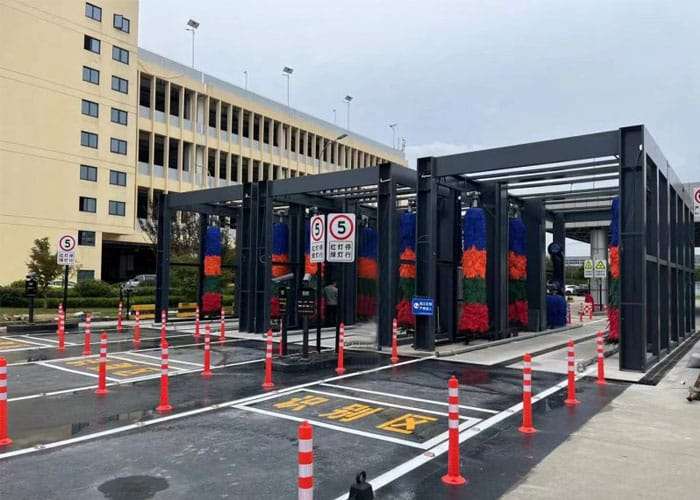
Watch a bus pass through the wash stations, shown without sound.
Match the brush arrangement, sensing and operation options to your vehicles and site.
Choose automatic, manual or individual-station operation.
Water-only and detergent washing suit different cleaning requirements.
Vehicle-position sensing and fault alarms support the driver and the operator.
Plan a clear route through the wash stations. The driver follows the approved speed and guidance instructions; the final program determines each cleaning stage.
Align the vehicle and follow the entry guidance.
The selected water and detergent stages prepare the surfaces.
The configured stations clean the passing vehicle.
Rinse away detergent and loosened dirt.
Wax and drying stations can be added.
Keep the exit clear and leave space between vehicles.
Start with the published brush arrangement and equipment footprint. The final configuration follows your fleet and site.
| Configuration | T4 | T5 | T6 |
|---|---|---|---|
| Machine footprint (L × W × H) | 8 × 5 × 5.3 m | 12 × 5 × 5.3 m | 18 × 5 × 5.3 m |
| Top brush | Customized | 1 | Customized |
| Vertical brushes | 2 | 2 | 4 |
| Skirt brushes | 2 | 2 | 2 |
| Installed power reference | 19 kW | 35 kW | 45 kW |
Equipment dimensions are converted from the millimetre values in the original table. The project drawings give the full site area, usable vehicle clearance, installed options and electrical demand.
Check vehicle clearance, approach and exit routes alongside the water and electrical supplies. Keep fleet circulation and maintenance access clear in the final layout.
| Equipment | Drive Through Bus Wash Machine |
|---|---|
| Models | T4, T5 and T6 |
| Machine dimensions (L × W × H) | T4: 8 × 5 × 5.3 m; T5: 12 × 5 × 5.3 m; T6: 18 × 5 × 5.3 m |
| Brush configuration | T4: 2 vertical, 2 skirt, top brush customized; T5: 1 top, 2 vertical, 2 skirt; T6: 4 vertical, 2 skirt, top brush customized |
| Vehicle types | Buses, trucks, train carriages and similar vehicles |
| Wash format | Vehicle moves through the wash stations |
| Wash time reference | 2–3 minutes per vehicle; depends on the selected program |
| Average throughput | 20–30 vehicles per hour |
| Water use reference | 150–200 L per vehicle; confirm program and water supply |
| Foam use reference | 25–30 mL per vehicle; confirm chemical settings |
| Electricity use reference | 0.5 kWh per vehicle |
| Machine power | T4: 19 kW; T5: 35 kW; T6: 45 kW |
| Supply reference | 380 V / 50 Hz, three-phase, five-wire |
| Vehicle width / height reference | 3.0 m / 4.0 m; confirm usable clearance, mirrors and roof fittings |
| Vehicle length | Confirm the approved length range for your fleet |
| Operation | Automatic, manual and individual-station control |
| Water recycling & drying | Confirm options and supplied scope in the quotation |
| Vehicle sensing | Dense photoelectric sensors measure each vehicle and adjust the wash in real time |
|---|---|
| Operator station | Weatherproof stand with a 14-inch touchscreen; card, coin and app payment |
| PLC control | Siemens (Germany), stable with a low failure rate |
| Brushes | EVA soft brushes with self-cleaning; they keep their shape and are gentle on paint |
| Fan drying | Drying power adjusts to the vehicle; drying rate over 95%; turbine fans with over 60% less noise |
| Motor reducers | SITI (Italy), fully enclosed, IP68 waterproof, service life over 20 years |
| Vehicle guidance | Full-plate guidance with automatic left and right adjustment; widened galvanized track for wider wheels |
| Foam & wax | Paint-safe foam detergent and hydrophobic shine wax; the shine lasts more than 3 days |
| Position sensors | Pepperl+Fuchs (Germany), IP69K waterproof; measure vehicle travel and position |
| Pipes & nozzles | Stainless steel |
Published reference specifications. Final dimensions, utilities and configuration are fixed in the project drawings and quotation.
Answers about clearance, wash capacity and installation.
The driver moves the bus through the wash area following the guidance and speed instructions. Cleaning stations run the selected program as the vehicle passes. Drivers are trained on spacing and the wash sequence before operation.
The published configurations differ in machine length, brush arrangement and installed power. Compare the table above, then select against vehicle bodywork, usable space and the required wash program. The largest model is not automatically the best fit.
The published wash-cycle reference is 2–3 minutes per vehicle. Actual fleet throughput also includes approach, driver alignment, vehicle spacing and exit time. Ask for a capacity estimate based on your operating plan.
The specification gives a width and height reference of 3.0 m and 4.0 m but no vehicle length. Send full dimensions including mirrors, roof fittings and protrusions, with vehicle photographs, and get the approved clearances before ordering.
Published machine footprints are 8 × 5 × 5.3 m for T4, 12 × 5 × 5.3 m for T5 and 18 × 5 × 5.3 m for T6. These are equipment dimensions, not complete site requirements. Allow for vehicle approach, exit, waiting, turning, maintenance and drainage using final drawings.
Yes, water recycling is offered. The quotation lists the treatment system, tanks, civil works and water-quality limits. Fresh-water demand varies by installation and is not fixed by the published wash-water figure.
It has automatic, manual and individual-station control, water-only and detergent washing, self-diagnosis and fault alarms. Payment and remote functions depend on the configuration.
Send the installation country, bus dimensions, fleet photos, daily volume, peak wash window, site plan and utility information. Request a proposed model, brush configuration, drawings and clear installation, training and support scope.
Compare drive-through washing with other fleet wash formats.
Compare fleet wash systems