
Customized conveyor
tunnel car wash system.
A conveyor tunnel built
around your site and wash stages.
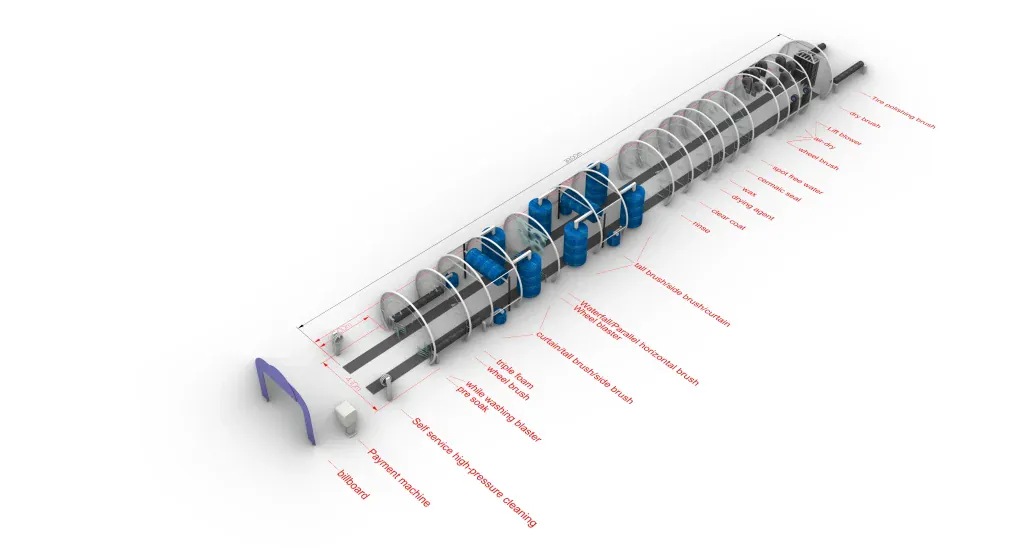
Plan the conveyor layout, washing stages and drying around your available space, vehicle flow and operating requirements.
Illustrated configuration: 40 m, 18 brushes, 120–150 cars per hour.
Your final configuration and throughput depend on the project.
See a customized
tunnel in operation.
Watch the conveyor, brush washing and drying stages in the original customized-system video.
Design the line
around your operation.
Choose the washing and drying sequence alongside vehicle transport, site access and controls.
Plan each
washing stage.
Use this sequence as a starting point. Your proposal defines the equipment and settings for each stage.
Prewash
Water loosens surface dirt.
Foam
Detergent prepares the vehicle for brushing.
Brush wash
Brush stages clean the body and wheels.
Rinse
Water rinses away detergent.
Water wax
Wax is applied in the configured program.
Drying
Dry brushes and fans complete the configured drying stage.
See a customized
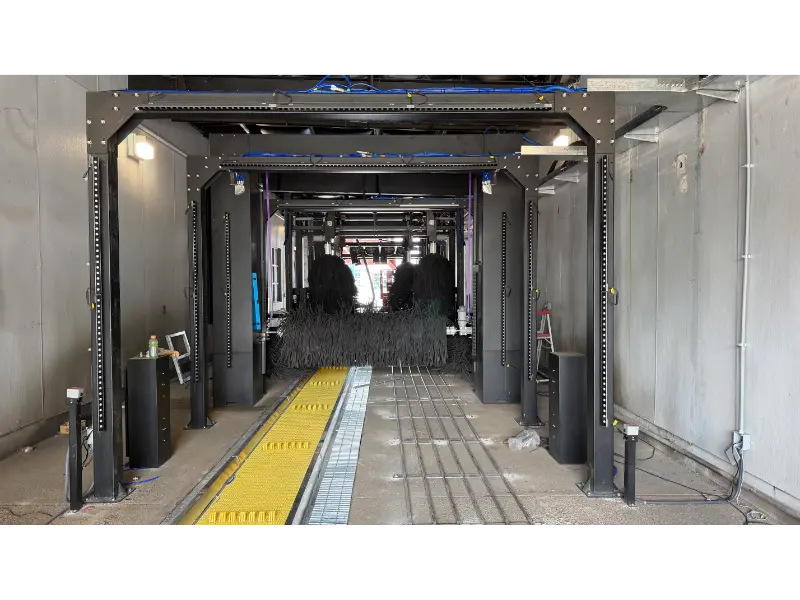
tunnel on site.
Explore a SHINEWASH conveyor tunnel installation in the United States. Use it as a reference for your own site layout and equipment.
View the installationReference figures
for a custom tunnel.
The figures below describe the illustrated 40 m system. Each custom project gets its own specification.
| Configuration | Illustrated 40 m customized system |
|---|---|
| Installation reference (L × W × H) | 40 × 5 × 3.2 m |
| Brushes | 18: 13 scrub brushes, 5 dry brushes |
| Published wash speed | 120–150 cars / hour |
| Conveyor | Dual conveyor belt |
| High-pressure pump | 7.5 kW, 316L stainless steel |
| Spray pressure | 2,000–3,000 PSI pulsed jets |
| Spray angle | Adjustable from 40° to 60° |
| Electrical reference | 380 V / 60 kW |
| Final layout & clearance | Designed for your project |
| Vehicle sensing | Dense photoelectric sensors measure each vehicle and adjust the wash in real time |
|---|---|
| Operator station | Weatherproof stand with a 14-inch touchscreen; card, coin and app payment |
| PLC control | Siemens (Germany), stable with a low failure rate |
| Brushes | EVA soft brushes with self-cleaning; they keep their shape and are gentle on paint |
| Fan drying | Drying power adjusts to the vehicle; drying rate over 95%; turbine fans with over 60% less noise |
| Motor reducers | SITI (Italy), fully enclosed, IP68 waterproof, service life over 20 years |
| Vehicle guidance | Full-plate guidance with automatic left and right adjustment; widened galvanized track for wider wheels |
| Foam & wax | Paint-safe foam detergent and hydrophobic shine wax; the shine lasts more than 3 days |
| Position sensors | Pepperl+Fuchs (Germany), IP69K waterproof; measure vehicle travel and position |
| Pipes & nozzles | Stainless steel |
Published reference specifications. Final dimensions, utilities and configuration are fixed in the project drawings and quotation.
Before you plan
a custom tunnel.
Answers about clearance, wash capacity and installation.
What can be customized in a conveyor tunnel system?
The layout and wash configuration are planned around your site dimensions, vehicle flow and operating requirements, including washing stages, brush and drying arrangements, vehicle guidance and controls.
Is every customized tunnel 40 m long?
No. The 40 × 5 × 3.2 m dimensions describe the illustrated configuration. Your project needs its own layout, clearance and utility requirements, including space for approach, queues and exit circulation.
Does every system have 18 brushes and wash 120–150 cars per hour?
Those are published references for the illustrated configuration. Brush counts and throughput depend on the selected equipment and washing program; your proposal gives the final equipment list and expected flow.
Can water recycling and payment equipment be included?
Yes. Water recycling and payment equipment can be supplied with the tunnel. The quotation lists the equipment, connections and services included.
How does a custom tunnel differ from Q9, Q11 and Q14?
The standard-model pages provide a starting configuration and installation reference. A customized project is planned around your site and operating brief. Compare the standard range if its footprint and washing stages fit your requirements.
What should I prepare for a customized tunnel quotation?
Send a site plan or sketch, usable dimensions, installation country, vehicle range, planned wash volume and utility details. Describe the washing, drying and control options you want, and whether you need delivery and installation.
Compare installation lengths and drying configurations.
Compare the tunnel range