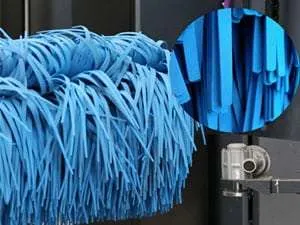
EVA soft brushes
Soft brush material for contact washing. Routine inspection and cleaning belong in your operating plan.

A 9-brush tunnel
on one continuous wash line.
Conveyor washing for cars, SUVs and MPVs. Plan a Q9 tunnel around your vehicle flow, available space and wash program.
Published capacity: up to 60 cars per hour.
Actual flow depends on configuration and vehicle spacing.
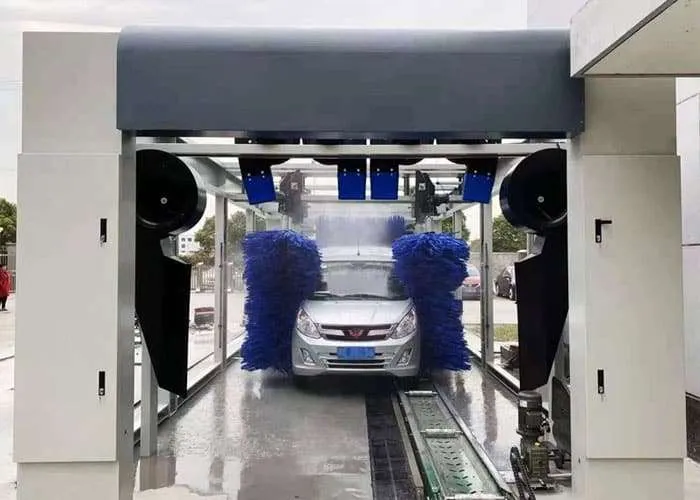
Watch the conveyor, brush washing and drying stages in the original Q9 product video.
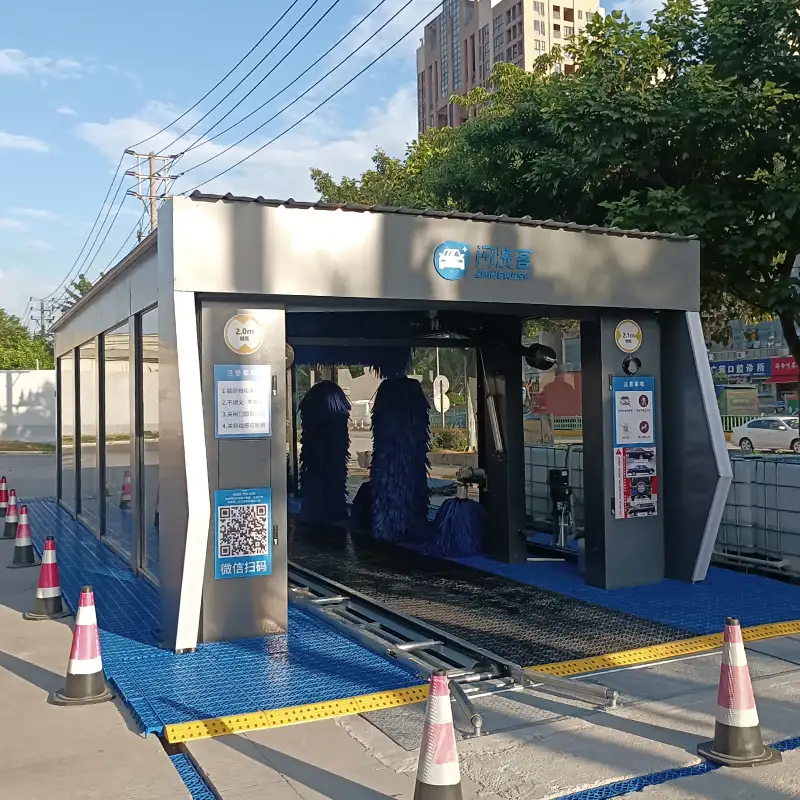
Q9 combines top, vertical and lower-body brushes in one conveyor system.
Need dedicated wheel brushes? Compare Q11 before choosing your configuration.
A conveyor connects each stage.
Water loosens surface dirt.
Detergent prepares the vehicle for brushing.
9 brushes clean the vehicle surfaces.
Water rinses away detergent.
Wax is applied in the configured program.
Fans remove remaining surface water.
Brush material, conveyor guidance and drying hardware work together through the wash sequence.
Soft brush material for contact washing. Routine inspection and cleaning belong in your operating plan.
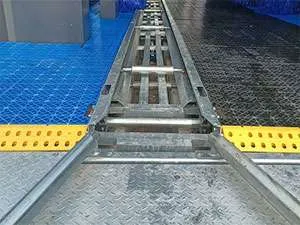
Wheel guidance aligns vehicles with the conveyor. Plan the approach, entry instructions and vehicle spacing.
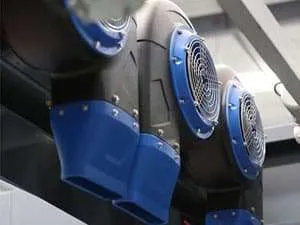
Air-drying hardware follows the washing stages. The fan configuration sets the electrical load.
The installation reference is larger than the machine itself. Allow additional space for traffic and service access.
| Model | Q9 conveyor tunnel |
|---|---|
| Brush configuration | 9: 1 top, 4 vertical, 4 skirt |
| Published wash speed | Up to 60 cars / hour |
| Wash cycle reference | 1.5–3 minutes per car |
| Equipment dimensions (L × W × H) | 12.5 × 4 × 3 m |
| Installation reference (L × W × H) | 24 × 4.5 × 3.2 m |
| Maximum vehicle size | Length unlimited; up to 2.3 m wide and 2.1 m high |
| Vehicle types | Sedans, SUVs & MPVs within clearance limits |
| Wheel brushes | Not included in the published Q9 configuration |
| Water use reference | 80–150 L per car; program dependent |
| Foam use | 7 mL per car |
| Water wax use | 12 mL per car |
| Electricity use reference | 0.6 kWh per car |
| Drying motors | 6 groups, 45 kW |
| Electrical supply | 380 V / 50 Hz, 21 kW |
| Vehicle sensing | Dense photoelectric sensors measure each vehicle and adjust the wash in real time |
|---|---|
| Operator station | Weatherproof stand with a 14-inch touchscreen; card, coin and app payment |
| PLC control | Siemens (Germany), stable with a low failure rate |
| Brushes | EVA soft brushes with self-cleaning; they keep their shape and are gentle on paint |
| Fan drying | Drying power adjusts to the vehicle; drying rate over 95%; turbine fans with over 60% less noise |
| Motor reducers | SITI (Italy), fully enclosed, IP68 waterproof, service life over 20 years |
| Vehicle guidance | Full-plate guidance with automatic left and right adjustment; widened galvanized track for wider wheels |
| Foam & wax | Paint-safe foam detergent and hydrophobic shine wax; the shine lasts more than 3 days |
| Position sensors | Pepperl+Fuchs (Germany), IP69K waterproof; measure vehicle travel and position |
| Pipes & nozzles | Stainless steel |
Published reference specifications. Final dimensions, utilities and configuration are fixed in the project drawings and quotation.
Answers about clearance, wash capacity and installation.
Q9 is a conveyor wash machine with 9 cleaning brushes. It moves passenger vehicles through washing and air-drying stages instead of washing one parked vehicle with a moving gantry.
The equipment measures 12.5 × 4 × 3 m. The published installation reference is 24 × 4.5 × 3.2 m. Your complete site also needs approach, waiting, exit and service areas.
The published Q9 configuration has 1 top brush, 4 vertical brushes and 4 skirt brushes, with no dedicated horizontal wheel brushes. Compare Q11 if wheel-brush cleaning is part of your requirements.
Sedans, SUVs and MPVs are listed for Q9, subject to a maximum vehicle width of 2.3 m and height of 2.1 m. Supply your largest vehicle dimensions and any roof equipment so the team can check clearance.
Throughput describes the line’s hourly vehicle flow, not the time each vehicle spends inside the tunnel. Wash stages, vehicle spacing and the selected program affect the actual operating rate.
Include the installation country, usable site dimensions, vehicle range, expected wash volume and available utilities. The quotation then covers configuration, electrical demand, delivery, installation, training and after-sales support.
Need more wheel-cleaning or drying stages?
Compare the tunnel range