In-Bay Automatic Car Wash: Types, Bay Size and Setup
An in-bay automatic car wash cleans a parked car inside a single wash bay. The driver pulls in and stops, and the machine does the moving. Choosing one comes down to the cleaning method, the number of cars you expect each hour, and the space and utilities your site can give it.
What an in-bay automatic car wash is
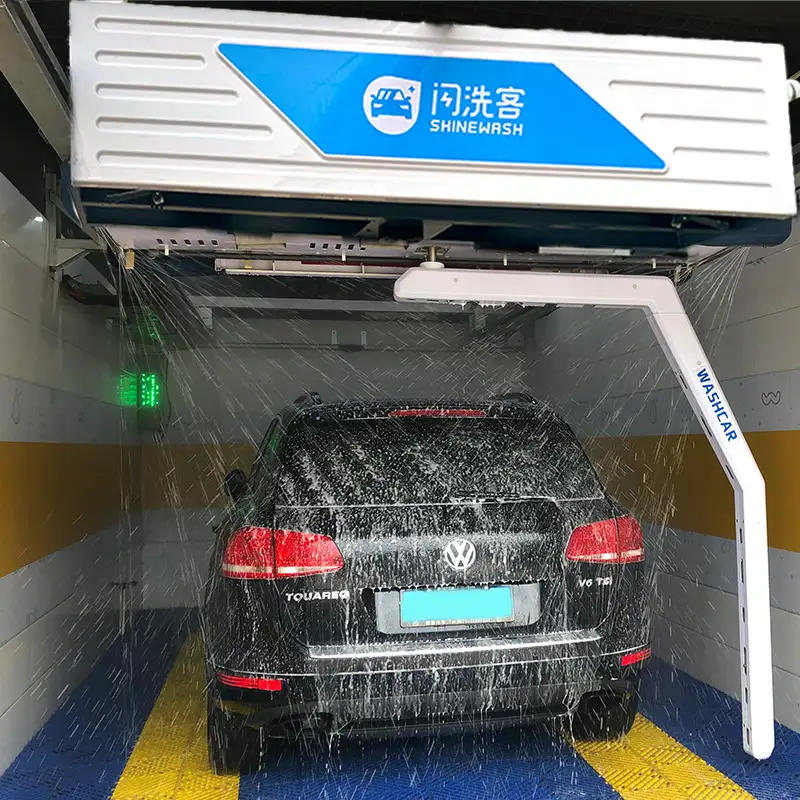
In an in-bay automatic, the car stays still. A touchless machine moves its spray arms around the car, and a rollover machine runs a gantry back and forth along it. A tunnel works the other way round: a conveyor pulls each car past a row of fixed stations, so several cars are washed at the same time. How tunnels and rollovers differ covers that choice.
Because it needs only one bay, an in-bay machine is common at gas stations, parking sites and self-service washes that stay open around the clock. SHINEWASH runs more than 1,000 car wash stations of its own at parking lots and gas stations.
Touchless or brush
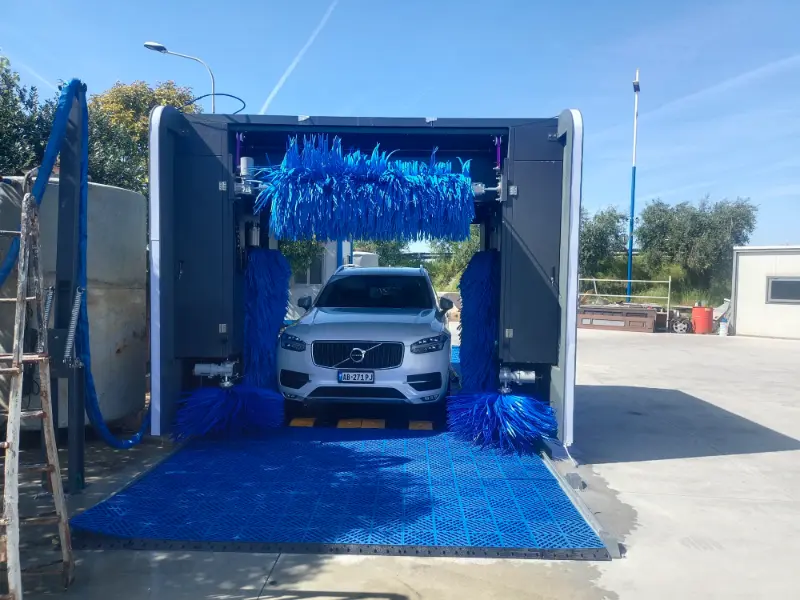
Touchless machines clean with high-pressure water and cleaning agents, and nothing touches the paint. Brush machines, often called soft-touch or friction washes, also scrub the car with rotating brushes. Professional Carwashing & Detailing sets out the trade-offs, summed up here:
| Touchless | Brush (rollover) | |
|---|---|---|
| How it cleans | High-pressure water and cleaning agents, with no contact | Rotating brushes with water and cleaning agents |
| Strong point | Nothing touches the paint, which suits new cars and wrapped or coated finishes | Removes heavy dirt and road film more easily |
| Watch for | Heavy, caked-on dirt may need a second pass | Brushes need regular cleaning and checks |
| SHINEWASH models | K6, K9, dual arm, up-and-down | S1, S3, S9, custom gantry |
The four touchless machines differ in how they reach the car. K9 moves its spray around the vehicle through 360 degrees and detects the vehicle’s width automatically. The dual-arm machine uses two robotic spray arms and takes vehicles up to 6.8 m long. The up-and-down machine measures the vehicle in 3D and moves its spray position with the vehicle’s height. On the brush side, the S1, S3 and S9 rollovers each use five brushes: one top, two vertical and two skirt brushes. K6 shares the K9’s size and wash time.
How many cars an hour
Each figure below is 60 minutes divided by the model’s published wash time per car, so it leaves out the time a car takes to drive in and out.
| Model | Wash time per car | Cars per hour |
|---|---|---|
| K6, K9 | 2–5 min | 12–30 |
| Dual arm | 3–8 min | 7–20 |
| Up-and-down | 3–6 min | 10–20 |
| S1, S3 | 2–5 min | 12–30 |
| S9 | 2.5–5 min | 12–24 |
If you expect more cars than one bay can take, a conveyor tunnel washes several cars at once. The model table in the tunnels and rollovers guide puts the S1, S3 and S9 next to the Q9, Q11 and Q14 tunnels.
Bay size
These are the installation sizes and largest vehicles from each model’s specification table.
| Model | Installation space (L × W × H) | Largest vehicle (L × W × H) |
|---|---|---|
| K6, K9 | 8 × 4 × 3.3 m | 6 × 2.6 × 2 m |
| Dual arm | 8 × 4 × 3.1 m | 6.8 × 2.4 × 2.2 m |
| Up-and-down | 9 × 4.3 × 3.5 m | 5.5 × 2.4 × 2.3 m |
| S1, S9 | 11 × 3.7 × 3.1 m | 6 × 2.1 × 2.1 m |
| S3 | 11 m long; width on the layout drawing | 6 × 2.1 × 2.1 m |
Leave extra room for the entrance, the exit and cars waiting in line. The final dimensions come from the layout drawing for your site.
Water, power and drainage
| Model | Water per car | Electricity per car | Power supply |
|---|---|---|---|
| K6, K9 | 90–140 L | 0.5–0.8 kWh | 380 V, 50 Hz |
| Dual arm | About 150 L | 1–1.5 kWh | 380 V, three phase, 45 kW |
| Up-and-down | 90–140 L | 0.5–1.0 kWh | Given in the quotation |
| S1 | 60–80 L | 0.3–0.5 kWh | 380 V, 50 Hz, 20 kVA; 25 kW total |
| S3, S9 | 60–80 L | 0.6 kWh | 380 V, 50 Hz, 20 kVA; 25 kW total |
Water use depends on the program you choose. A water recycling system treats the wash water so part of it can be used again; the water recycling guide explains how it works. Plan the drainage route and the local discharge rules at the same time.
Preparing the site
Before you ask for a layout, gather these details:
- Usable length, width and clear height, plus the entrance, exit, queue and turning areas.
- The length, width and height of the largest vehicle, and the number of cars you expect.
- Water supply pressure, water quality, the drainage route and any local treatment rules.
- Available voltage, phase and power capacity.
- Whether you need a building or an equipment room and how customers will pay.
What to send for a layout
Send the size of your site and the number of cars you expect each day, and your proposal then sets out the equipment, layout drawings, delivery and installation guidance. If you sell or install car wash equipment, see how to become a SHINEWASH distributor.